Every LEO satellite launched today carries an implicit expectation: the next one must perform
better. That imperative drives relentless iteration: faster design cycles, tighter validation, and
real-world signal data that actually feeds back into engineering decisions. Yet for most teams, a
structural gap persists between the lab environment where systems are designed and the orbital
environment where they actually operate.
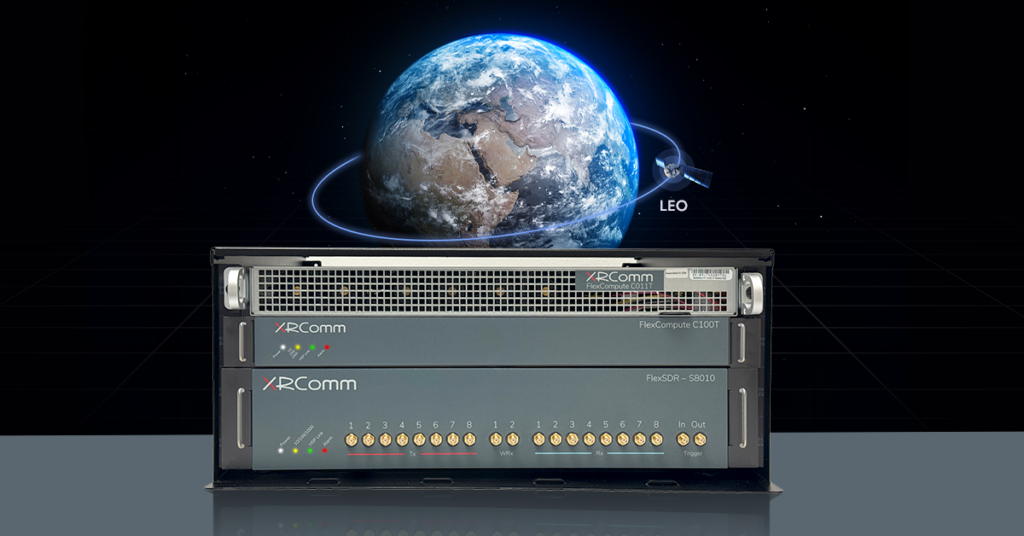
TruSystems® is XRComm’s answer to that gap. Not another test tool or a standalone SDR
platform, but a unified hardware architecture that serves multiple operational roles through
software-defined personalities eliminating the disconnect between prototyping and field
deployment at the platform level.
NTN systems, particularly LEO constellations, encounter conditions in orbit that no controlled
test environment can fully replicate. Launch-induced mechanical stress alters RF characteristics.
Thermal cycling in space affects carrier stability and timing alignment in ways that pre-launch
thermal modeling only approximates. Doppler dynamics across orbital passes, inter-beam
interference in multi-beam architectures, and atmospheric propagation effects introduce signal
behavior that emerges only under live operational load.
The consequence is a diagnostic challenge that shows up post-deployment: anomalies that
weren’t present in the lab, root causes that take days to identify, and design corrections that miss
the next launch window. For teams operating under the performance and reliability expectations
of modern NTN services such as direct-to-cell, payload verification, multi-orbit QoS
management, that lag is operationally costly.
The standard industry response has been to maintain separate hardware stacks for development
and field testing. That separation compounds the problem. Prototyping teams and field validation
teams work from different toolchains, different data formats, and different mental models of
system behavior. Knowledge transfer between the two is slow, and the insights generated in the
field rarely arrive in the design environment in time to be applied.
TruSystems® resolves this by making the hardware a shared infrastructure. The same physical
platform runs two software personalities, each purpose-optimized for its role in the development
and deployment lifecycle.
The TRS100P personality is the prototyping and development layer. It supports wireless system development across 5G, 6G, and NTN architectures, with native integration for open-source
stacks including OAI and OCUDU. It provides real-time labeled data logging, AI/ML workflow
support, and a realistic environment for satellite payload development, UE and customer terminal
design, and digital twin modeling using live operational data as its grounding signal.
The SAT100T personality is the field deployment layer — a real-time satellite signal monitoring and diagnostics platform designed for continuous operation in live environments. It provides
Doppler offset and rate-of-change tracking, EVM, RSSI, RSRP/RSRQ, inter-beam interference
detection, and sub-frame timing stability monitoring. Anomaly detection runs at the hardware
layer via the AppIQ-RFanomaly engine on the C1001 FPGA, with configurable custom triggers,
pre/post-capture buffers, and detection latency measured in nanoseconds. The SAT100T does not
flag thresholds — it captures precisely the events that engineering teams define as diagnostically
relevant, within the orbital window where those events occur.
The platform characteristics supporting both personalities are consistent across the stack: ultralow latency data transport, real-time deterministic distributed DSP, native AI/ML inference at the
edge, wideband multi-channel SDR with adaptive calibration, and a scalable software-defined
architecture that accommodates deployment growth without hardware replacement.
Each personality of the TruSystems platform functions as a complete platform in its own right,
delivering full capability for either prototyping or testing while improving the efficiency and
effectiveness of your design and test teams. In addition, when both personalities are used to
create a seamless, continuous workflow between development and test, rather than relying on the
traditional siloed approach imposed by conventional instrumentation, your teams can fully
leverage their combined strengths to accelerate design cycles, maximize return on investment,
and drive faster, more confident time-to-market.
In practice, this means field signal data captured by the SAT100T such as anomalies, Doppler
profiles, timing drift measurements, interference events, flow back to ground systems and
directly informs the design environment where the TRS100P operates. Pre-Doppler models get
refined. Waveform parameters get tuned against real orbital behavior. Performance drift
discovered post-deployment gets compensated in the next design iteration with empirical data
rather than conservative assumptions.
Each launch cycle, in other words, is informed by the operational reality of the previous one. The
feedback loop is closed not by process or convention, but by architecture: the same hardware, the
same data formats, the same toolchains on both sides of the design-deployment boundary.
This matters most in the compressed iteration cadences of LEO constellation programs, where
launch windows are fixed and the margin for carrying forward unresolved performance issues is
narrow. A platform that shortens the distance between anomaly detection in the field and
corrective action in the lab directly improves what can be achieved between launches.
For engineering leadership, the implications extend beyond technical performance. A single
hardware platform across development and field teams reduces procurement complexity and
eliminates redundant inventory. Unified toolchains mean that engineers move between
prototyping and field validation contexts without re-learning instrumentation. AI/ML models
trained on labeled MetaIQ data in the prototyping environment can be deployed directly to the
edge compute layer in the field — no pipeline rebuild, no format translation.
The total cost of ownership argument is straightforward: fewer hardware units, faster
onboarding, and a data pipeline that generates value on both ends of the development cycle
rather than siloing insight in the team that generated it.
TruSystems® was born from rethinking of where the boundary between design and deployment should sit — which is to say, it shouldn’t be a boundary at all. For NTN engineering teams where each launch cycle must build on the last, a platform that connects prototyping, field measurement, and continuous optimization into a single coherent workflow is not a convenience. It is an operational requirement.