
Why LEO NTN Requires a New Class of Field Measurement Systems
Table of Contents
- Why LEO NTN Requires a New Class of Field Measurement Systems
- The Single-Pass Problem Nobody Planned For
- Engineering for the Physics of LEO
- Real-World Impairments as Development Inputs
- The Coexistence Question Operators Cannot Ignore
- Ka-Band Backhaul and the Instantaneous Bandwidth Problem
- Closing the Test-Design-Test Loop
- From “Does It Work” to “How Do We Scale”
- FAQs
Why LEO NTN Requires a New Class of Field Measurement Systems
A usable LEO pass may last only two to ten minutes, depending on altitude, elevation angle, link budget, and ground location. Doppler is a first-order challenge: at 700–900 MHz, it can reach roughly 17–22 kHz at peak; at the upper end of L-band, around 1.6 GHz and above, it can approach or exceed 40 kHz, depending on carrier frequency, elevation angle, and pass geometry. The channel changes continuously. Depending on frequency, elevation angle, mobility, terrain, blockage, and local interference, the received signal may combine a dominant line-of-sight component with reflections, fading, and other forms of signal degradation.
Terrestrial cellular test methods are not obsolete for LEO NTN, but they are incomplete without field-deployable, Doppler-aware instrumentation that captures what happens during the pass. Existing T&M architectures address important parts of the problem in the lab, but they were not built around the field-measurement requirements that LEO NTN demands. That gap is what XRComm’s SAT100T was engineered to close.
The Single-Pass Problem Nobody Planned For
Terrestrial test methodology is built on repetition. In a LEO pass, you cannot recreate the RF event: the geometry will not repeat for hours or days, and when it does, ionosphere, payload state, weather, and interference will have shifted. Every pass becomes a high-value measurement opportunity, sometimes a one-shot experiment. Traditional UE emulators and lab-based test systems remain important but were not designed to capture the full live RF environment of a moving pass.
What the field needs is a field-deployable reference measurement node: a T&M-grade RF/IQ platform that captures the live RF environment in real time and correlates with PHY, MAC, network, and system-layer observations. The term is analogous to “golden UE” in conformance testing, but purpose-built for field conditions rather than the lab. A golden UE tells you whether a device passes a test; a measurement reference node tells you why the link behaved the way it did under live operating conditions.
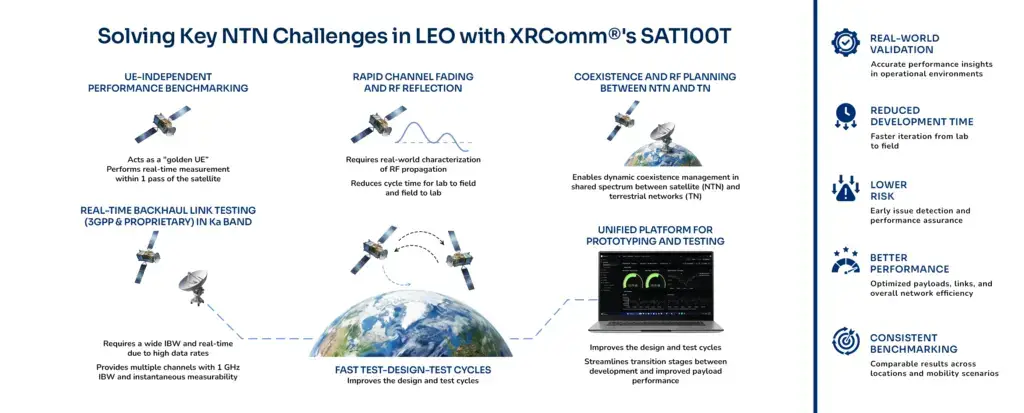
SAT100T captures wideband RF/IQ during a single pass and derives received power, frequency and timing behavior, signal quality, and event-tagged anomalies. Paired with UE, network, or protocol logs, those measurements correlate with system-layer behavior across locations, elevation angles, and mobility profiles, making pass-to-pass benchmarking achievable rather than aspirational.
Engineering for the Physics of LEO
Doppler is more than absolute frequency offset. The receiver must track Doppler rate (i.e., the continuous change in offset through the pass) which affects acquisition, synchronization, receiver tracking, and measurement accuracy. Doppler also introduces a time-domain scale factor: the signal is time-compressed or time-expanded as the satellite approaches or recedes. In narrowband waveforms like NB-IoT this matters. Frequency-domain correction alone leaves residual timing distortion; a full Doppler model must account for both the frequency shift and its time-scaling equivalent.
Propagation delay is another fundamental difference. LEO round-trip delay is 4–20 ms depending on altitude and elevation angle, versus well under a millisecond terrestrially — with direct consequences for timing advance, synchronization, scheduling, and PRACH procedures.
Standards Note: 3GPP Release 17 addressed NTN propagation delay explicitly by disabling HARQ retransmissions in NTN configurations where the round-trip delay would make HARQ impractical. This is a significant architectural departure from terrestrial LTE and NR, and it means NTN validation must measure not only RF quality and raw timing, but also how the link behaves under HARQ-disabled scheduling — a regime that has no direct analogue in terrestrial test methodology.
Direct-to-device links experience propagation effects unlike traditional high-gain fixed satellite links. A signal at 900 MHz does not behave like a Ku-band link; it interacts with foliage, buildings, terrain, clutter, and moving objects. Beam transitions, visibility windows, and handover behavior also enter the validation problem — characterizing this hybrid environment requires field-capable instrumentation, not anechoic chamber emulation.
SAT100T’s AppIQ-Doppler module performs real-time correction of both the frequency-domain Doppler shift and its time-domain scaling equivalent preserving waveform fidelity across the pass rather than correcting offset alone. Its RF anomaly module tags transient RF events as they occur during the pass, preserving the operational context that post-hoc analysis may otherwise miss. Together, these capabilities address the two most acute instrumentation gaps in live NTN field validation: accurate Doppler handling and event-correlated anomaly capture.
Real-World Impairments as Development Inputs
The Coexistence Question Operators Cannot Ignore
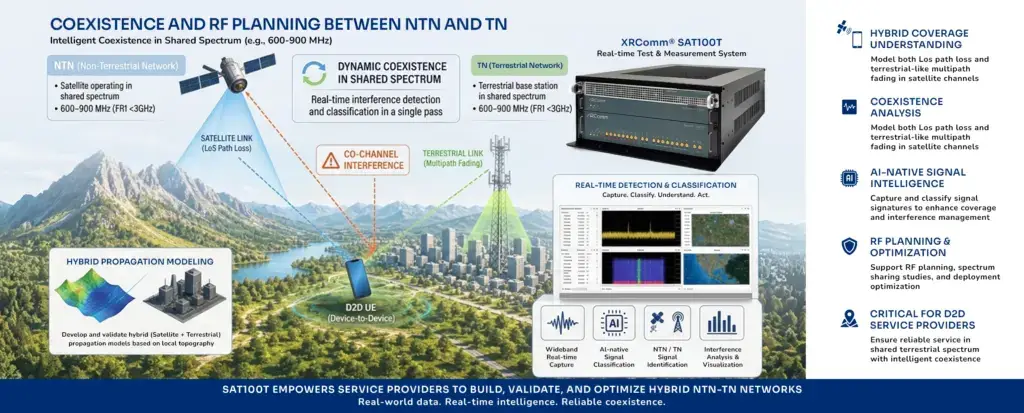
As direct-to-device and IoT-NTN services expand across MSS spectrum and, in some markets, operator-controlled terrestrial mobile spectrum, coexistence becomes operational rather than academic. The 600–900 MHz and sub-3 GHz bands are crowded: mobile operators, broadcast incumbents, and satellite D2D providers may operate in overlapping spectrum, making interference analysis dependent on geography, licensing, time of day, and the satellite’s instantaneous footprint.
Link budgets built from generic assumptions can over- or under-predict coverage once terrain, foliage, clutter, and local interference enter the picture. Service providers need models grounded in local topography and validated against live measurements. SAT100T’s real-time interference detection and signature classification let operators identify and tag interferers within the pass, building the empirical basis for coexistence planning that purely simulated approaches cannot match.
Ka-Band Backhaul and the Instantaneous Bandwidth Problem
Closing the Test-Design-Test Loop
From “Does It Work” to “How Do We Scale”
NB-IoT NTN is transitioning from proof-of-concept to commercial deployment. The question is: how consistently can it be delivered, at what cost, across which geographies, and under what interference, mobility, and service-continuity conditions? Answering this requires measurement infrastructure built for LEO: single-pass fidelity, real-time Doppler handling with time-scale correction, timing awareness that accounts for HARQ-disabled NTN scheduling, hybrid-channel characterization, coexistence visibility, wide instantaneous bandwidth for feeder and backhaul links, and a unified workflow from validation to prototyping.
That is the measurement category XRComm is building: field-deployable RF instrumentation that helps NTN teams capture what happens during a LEO pass, correlate it with system behavior, and shorten the path from validation to deployment. Satellite IoT will be defined by who can engineer, validate, and scale most reliably. The instrumentation has to match the ambition.
FAQs
What is LEO NTN, and why does it require specialized field measurement systems?
LEO NTN (Low Earth Orbit Non-Terrestrial Network) enables NB-IoT and LTE-M devices to communicate through satellites instead of terrestrial cell towers. Unlike terrestrial networks, LEO satellites move rapidly relative to the ground, creating challenges such as Doppler shift, propagation delay, and changing link conditions. Specialized field measurement systems are required to accurately capture and analyze these dynamic RF behaviors during live satellite passes.