
Beyond Simulation: Building the Experimental Foundation for Next-Generation Wireless
Explore this content with AI
Beyond Simulation: Building the Experimental Foundation for Next-Generation Wireless
Wireless research is changing character. Simulation and controlled link-level experimentation have long provided the foundation for developing and evaluating new wireless concepts. As research advances through 5G-Advanced and toward 6G, however, an increasing class of problems cannot be understood adequately without observing how algorithms, RF hardware, propagation, mobility, network state and AI interact in the physical system. The systems under investigation are mobile, distributed, sensing-aware, software-controlled and increasingly adaptive; their behavior emerges from these interactions rather than from any one layer in isolation.
This raises a problem simulation alone cannot resolve. The more adaptive a network becomes, the harder it is to know exactly what happened in the physical system, and the harder still it is to reproduce it. National research infrastructure such as the NSF-funded PAWR platforms (POWDER, COSMOS, AERPAW and ARA) reflects this change: research is increasingly complementing simulation and emulation with over-the-air and field validation. The open question for any research team is what it now takes to trust that an experimental result reflects the physical system rather than the test setup.
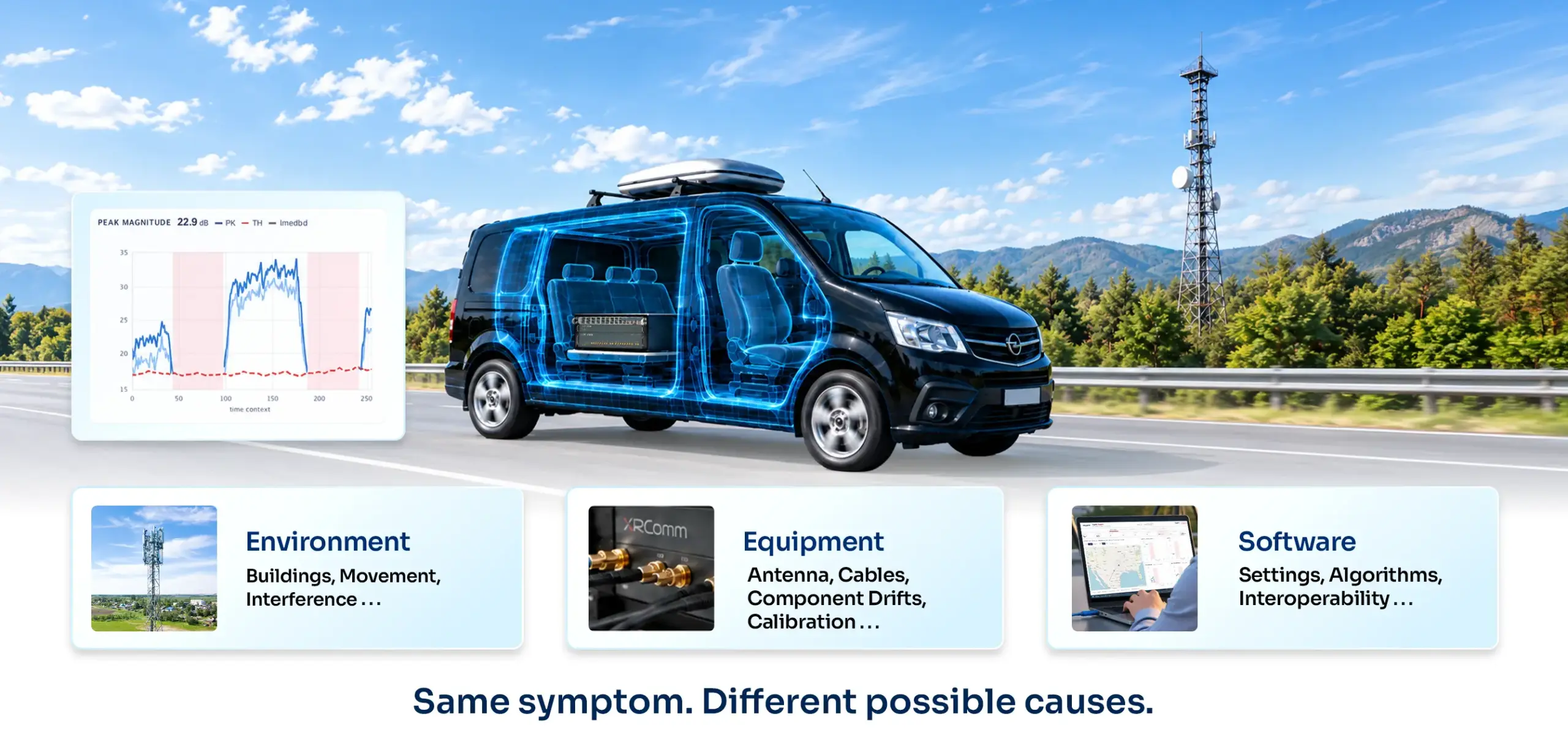
Four converging research domains make the shift concrete. Each poses a different physical challenge, yet together they reveal a shared experimental problem.
Four converging research domains
01. Upper mid-band (FR3)
The upper mid-band, roughly 7.125–24.25 GHz and commonly referred to as FR3, is often characterized as a “golden band” because it may combine substantially more spectrum opportunity than traditional FR1 deployments with more favorable propagation than FR2/mmWave. The opportunity is not a single clean allocation: much of the range is occupied or shared, making coexistence and spectrum access part of the research problem. Existing channel datasets across this range are comparatively sparse, and the propagation behavior itself changes: electrically large arrays can see different conditions across the aperture, so near-field effects and spatial non-stationarity become measurable design factors. As arrays scale from massive toward gigantic MIMO, phase, gain and timing calibration turn into first-order research tasks. The central measurement question is whether observed behavior comes from propagation physics or from array, RF-chain or instrumentation impairment.
02. Integrated sensing and communication (ISAC)
Here the communication network also observes the physical world, using its waveforms and infrastructure to detect, localize and track. ISAC remains largely in study and pre-normative development rather than a finished 6G capability with Releases 19 and 20 advancing service, channel-modeling and NR sensing studies. The central experimental challenge is correlation: tying each sensing return to a known physical event or target while preserving the communication-waveform context. Monostatic, bistatic and multistatic geometries also raise requirements for timing, phase coherence and calibration across nodes. Applications range from counter-UAS to infrastructure monitoring, private-network localization and environmental awareness. Research across these applications requires reliable physical ground truth; for AI-enabled sensing, that ground truth must be represented in labeled data that connect RF observations to known targets and events for model training and validation.
03. Non-terrestrial networks and TN/NTN convergence
3GPP Release 17 established the initial NR-NTN and IoT-NTN baseline, centered initially on transparent-payload satellite architectures and GNSS-assisted terminals. LEO links behave unlike terrestrial ones: geometry changes rapidly, bringing large Doppler shifts, variable propagation delay, elevation-dependent conditions, beam movement and frequent handover. Link behavior couples tightly to UE position through timing advance and Doppler pre-compensation, making degraded or unavailable GNSS a key research variable. Release 20’s GNSS-resilient NR-NTN study, examines operation when reliable UE positioning or GNSS assistance cannot simply be assumed. Increasingly, NTN is also a network-integration question concerned with service continuity as a device moves between terrestrial and non-terrestrial access domains. Studying it well requires recreating dynamic orbital and link conditions in the lab before committing to field trials or launch.
04. Open and AI-enabled RAN
Disaggregated, open architectures make the network programmable and, for researchers, experimentally accessible. O-RAN introduces programmable control points through rApps associated with the Non-RT RIC and xApps associated with the Near-RT RIC, providing defined points where new algorithms can enter the RAN control stack. AI-enabled RAN experiments must account for the different timescales of real-time PHY processing, near-real-time control and non-real-time optimization. Large-scale emulation environments such as Northeastern’s Colosseum, together with frameworks such as OpenRAN Gym, show how research can progress from controlled emulation toward more realistic experimentation. Emulation is one element of a digital-twin methodology: a useful twin requires a faithful, measured and continuously tested relationship between the physical system and its digital representation. Open RAN software projects such as OpenAirInterface and OCUDU lower the barrier between research code and operational wireless systems, while AI-enabled RAN research extends this toward data-driven adaptation and control.
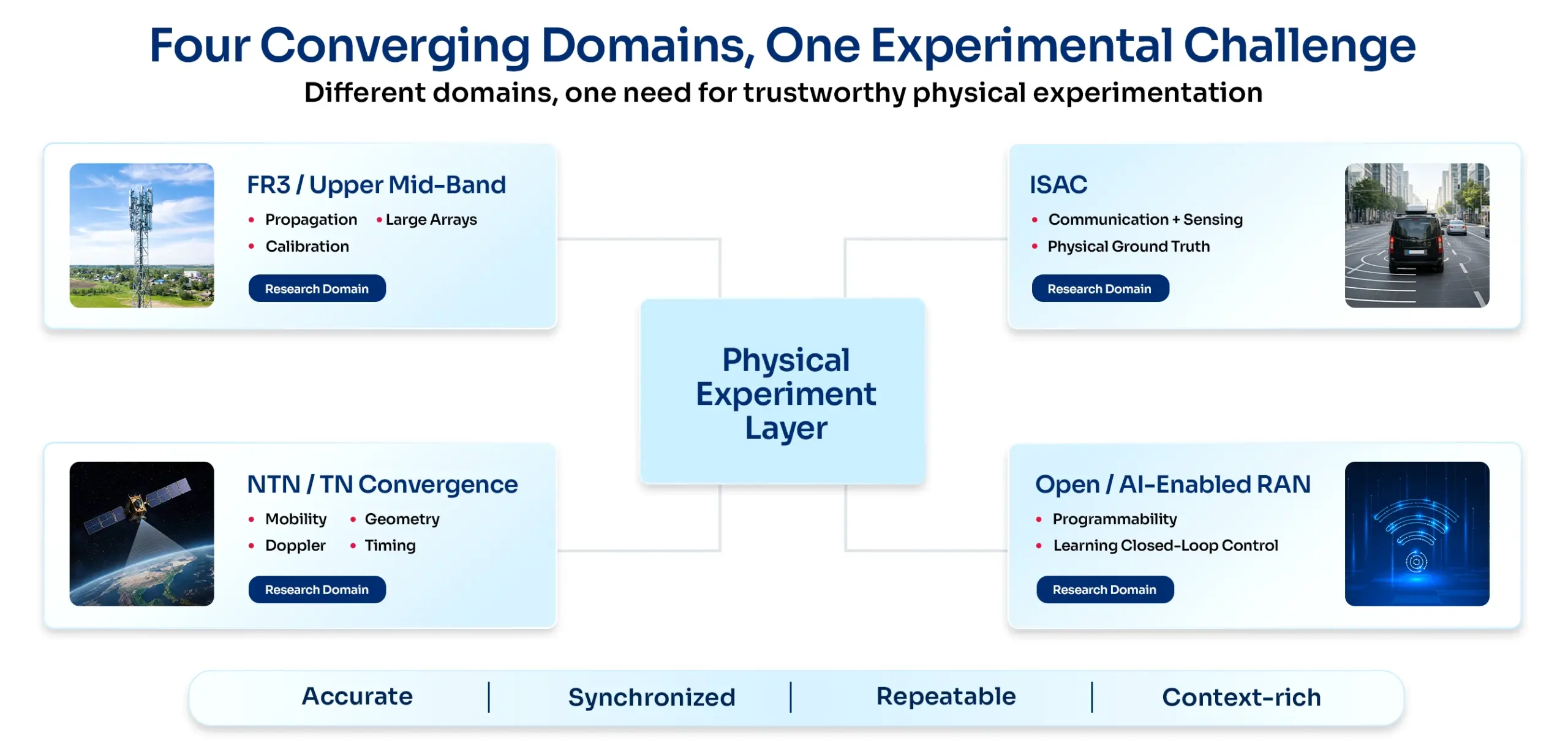
Figure 1 — Four converging research domains revealing a common physical experimentation challenge
Across all four domains, AI has become a horizontal layer more than a single topic: beam and channel prediction in FR3, target classification in ISAC, mobility and handover optimization in NTN, and control and optimization in AI-RAN. A central challenge is domain shift: a model trained on synthetic, simulated or controlled laboratory data may encounter a materially different distribution in the field. Trustworthy physical RF data, complete experimental context and repeatable conditions therefore become part of model quality itself. AI raises the value of accurate physical measurement rather than reducing the need for RF expertise.
Seen together, these domains converge on a common set of experimental primitives. The technologies differ, yet the infrastructure requirements increasingly align around establishing trustworthy physical RF ground truth:
AI as a horizontal layer
- RF fidelity, calibration and measurement uncertainty, so researchers can distinguish the signal, channel or impairment under study from effects introduced by the experimental setup
- Time and phase coherence across the channels or nodes an experiment spans, with a trustworthy reference and known alignment error
- Determinism and triggering that capture the event of interest with configurable pre- and post-trigger context
- Context-rich RF data: IQ or PHY observations bound to synchronized experimental context such as configuration, timing, location, antenna or beam state, software version, network state, calibration state and event metadata
- Real-time compute for sensing, adaptive algorithms and AI inference
- Open programmability that reaches the layers a researcher is trying to change
- Reproducibility, so an experiment and its calibrated context can be repeated, modified and compared
- Lab-to-field continuity, so a common workflow and evidence model survive the move toward real deployments
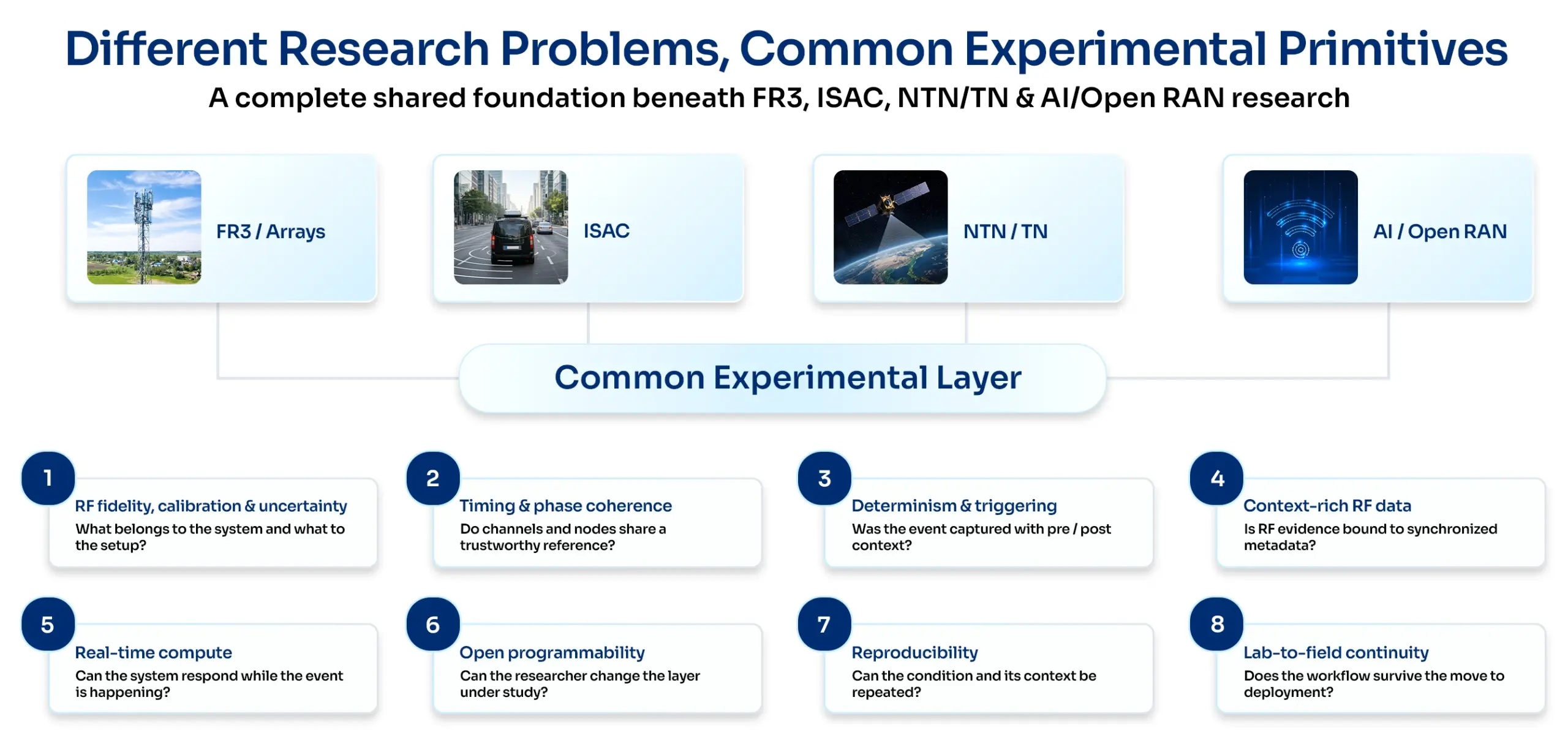
Figure 2 — Different research problems, common experimental primitives.
From simulation to field: a closed loop
This common base reveals a workflow more than a single test: simulation remains essential for rapid exploration; emulation adds controlled timing, RF and protocol behavior while keeping experiments repeatable; hardware-in-the-loop exposes real implementations and RF chains to those conditions; over-the-air experimentation introduces antennas and physical propagation; and field trials supply the environmental complexity no model fully anticipates. The return path changes the research model. The objective is no longer simply to validate a design against a predefined condition; it is to create an experimental loop in which physical observations continuously refine models, algorithms and subsequent experiments. Field observations flow back into the model, the test conditions and the algorithm, so the loop does not end at validation. Simulation and physical experimentation operate as a continuum: model → emulate → implement → observe → learn → modify → reproduce → test again.
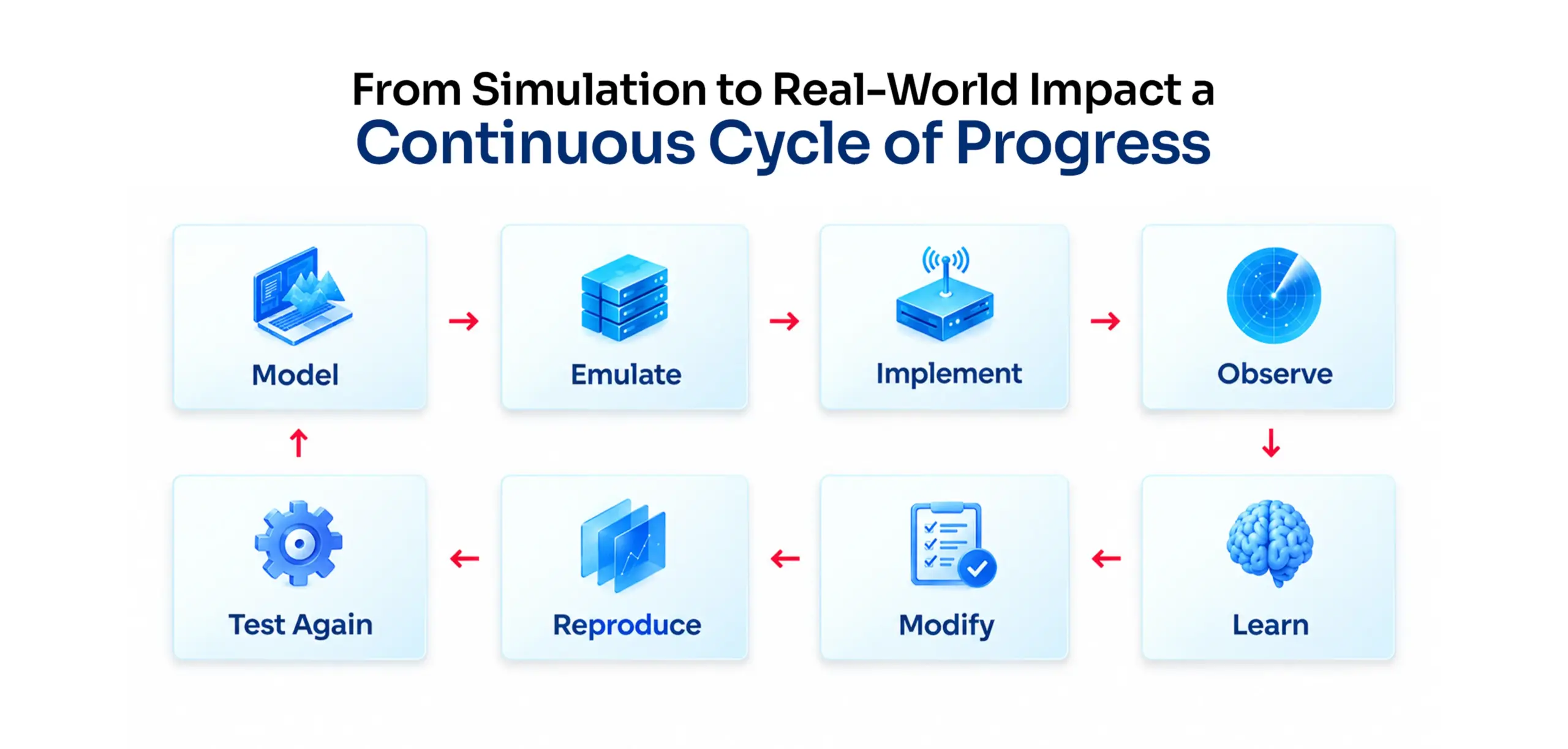
Figure 3 — From simulation to Real-World impact.
The workflow XRComm built TruSystems to support

FAQs
Why is traditional simulation no longer enough?
What core research domains require RF ground truth?
- FR3 (Upper Mid-Band): Needs precise calibration for near-field effects and large array propagation.
- ISAC: Requires correlating RF returns directly with real physical targets.
- NTN / TN Convergence: Involves high LEO satellite mobility, Doppler shifts, and GNSS resilience.
- Open & AI-RAN: Requires actual physical data to train models and prevent field performance drops (domain shift).