
Beyond the Lab: Real-Time In-field Satellite Signal Monitoring
Table of Contents
PRODUCT SPOTLIGHT TruSystems® SAT100T
The Operational Problem
The gap between lab-validated performance and in-field signal behavior is where outages originate, where waveform anomalies go undetected, and where root cause diagnostics become expensive and slow. For teams operating under the coverage, latency, and reliability expectations of modern NTN consumer services, that gap is operationally unacceptable.
The TruSystems SAT100T is built specifically to close it.
What is the TruSystems SAT100T
It is technology-agnostic, supporting both proprietary custom waveforms and 3GPP standards-based NR-NTN direct-to-cell applications across multi-orbit architectures.
The Platform is designed with next-generation and NTN wireless systems in mind with capabilities such as continuous in-field performance monitoring of satellite signals in live, real-world conditions, real-time anomaly detection for custom and multi-RAT waveforms, including direct-to-cell NR-NTN deployments, multi-orbit architecture performance testing and comparative analysis, UE/CT and payload characterization, or inter-beam interference detection and measurement and many more.
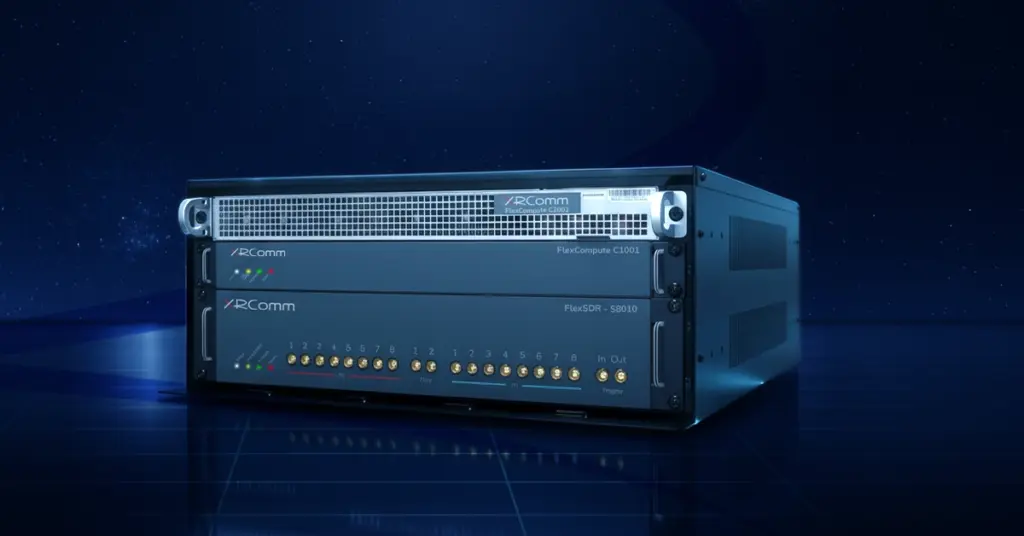
System Architecture
- Multiple QSFP-DD ports at 200 Gbps each, plus optional additional 100 Gbps ports
- Large memory banks for high-speed data buffering
- Real-time execution of AppIQ IP modules including AppIQ-Doppler (true real-time Doppler compensation) and AppIQ-RFanomaly (custom-trigger RF anomaly detection)
- Support for up to 10 Rx and 8 Tx channels with very high aggregate bandwidth across all channels
- Programmable via FlexWave driver suite (Python, C/C++, LabVIEW, VISA/SCPI)
- Options with reprogrammable FPGA
- External reference and flexible trigger I/O for synchronization
- Multi-core CPU with real-time
- Multiple 100 Gbps QSFP28 data ports + two 10 GbE RJ45 control ports
- 200 Gbps internal interconnect throughput
- Open and reprogrammable
- Real-time Doppler reversal and correlator
- Timing detection algorithms
- ECEF and GPS location integration
- Custom correlation sequence definition
- Anomaly detection configuration and user interface tooling
RF Signal Metrics
- Error Vector Magnitude — modulation quality assessment
- Real-time Doppler offset and rate-of-change tracking across orbital passes; AppIQ-Doppler provides true Doppler compensation regardless of platform mobility
- Received Signal Strength Indicator at the measurement point
- Reference Signal Received Power and Quality — applicable to NR-NTN and direct-to-cell deployments
- Sub-frame timing and carrier frequency stability tracking to detect drift before cascade failure
- Absolute and relative received power measurement
- Measurement of interference between satellite beams — particularly relevant in multi-beam LEO architectures
Instantaneous Bandwidth and Channel Configuration
The SAT100T’s RF capture capability is defined by the S8010 FlexSDR module, which provides ultra-wide native IBW. Full specification details are available from the factory. (Contact XRComm for IBW configuration options.)
In the standard channel configuration, the SAT100T has eight receiving and eight transmitting channels, and the extended configuration features two additional receiving channels for high-bandwidth mode.
Scalability: A single C1001 FlexCompute FPGA module can manage up to four SAT100T SDR units operating in parallel, with phase-coherent synchronization across units. This enables wideband coverage expansion or spatial diversity configurations for large-scale field deployments. A single C2002 FlexCompute Server can handle multiple C1001 FlexCompute FPGA modules.
The two additional WRx(×2) paths provided in the extended configuration support dual software personalities, enabling flexible deployment across distinct operational modes.
In Test & Measurement personality, the extended channels operate as wideband receivers with instantaneous bandwidth, supporting high-fidelity signal capture across wide spectral spans.
In Prototyping personality, the wideband channels function as Observation Receiver (OBRX) paths, delivering direct transmitter feedback to the host system. This facilitates Digital Pre-Distortion (DPD) algorithm development, Tx signal tracking, and LO leakage calibration — providing a closed-loop reference architecture without requiring external instrumentation.
Anomaly Detection — AppIQ-RFanomaly
- Custom-defined anomalies and triggers — engineering teams define the detection conditions relevant to their waveform and operational context
- Pre/post-capture buffers — the system captures signal data before and after the trigger event, providing full context for root cause analysis without requiring continuous raw data storage
- Time-based and event-based recording — minimizes storage overhead while ensuring no relevant signal event is lost
- Detection within satellite window — capable of capturing anomaly events within a single satellite orbital pass, critical for LEO deployments where revisit windows are limited
- Detection latency: At sample rates (nanseconds)
AI/ML Integration — FlexCompute Edge Intelligence
Supported Capabilities:
- Long-term performance trend analysis running continuously across deployment lifetime
- Real-time edge inference of customer-defined AI/ML models
- Native data labeling at the point of capture, accelerating training dataset generation for custom waveform anomaly classifiers
- Open API supporting customer database— accessible through FlexWave driver suite
- Customer proprietary IP deployment on the FlexCompute platform — teams can deploy their own algorithms.
The practical implication for NTN operations teams is a system that moves from reactive monitoring — detecting problems after they affect users — to predictive monitoring, where statistical deviation from baseline performance triggers investigation before service degradation occurs.
The TruSystems SAT100T enables real-time diagnostics, smart anomaly detection, and an open platform that can grow with future requirements. It is available with an 8-hour field support package (SP001) and a renewable yearly product support plan (SP000).
Contact XRComm at info@xrcomm.com or contact for platform configuration details and deployment support.