
Not All Satellite Transitions Are the Same Event
Table of Contents
- Not All Satellite Transitions Are the Same Event
Explore this content with AI
- ChatGPT
- Claude
- Perplexity
- Google AI Mode
- Grok
NTN Challenges Series | Part 1
Not All Satellite Transitions Are the Same Event
Rethinking Handover in LEO NTN
In terrestrial 5G, handover generally describes a UE transition between serving cells or RAN nodes, with the infrastructure assumed to be geographically stationary. In LEO NTN, the serving geometry itself evolves continuously as satellites and beams move relative to the UE. Using a single design pattern for all of them is where most NTN mobility architecture goes wrong, and it is the root cause of the handover failures that surface in integration testing and field trials.
There is a further complication with no terrestrial analog: in cellular networks, mobility is triggered by the user’s movement relative to static infrastructure. In LEO NTN, the serving geometry changes continuously even when the UE is stationary because the satellite moves relative to the user. A device sitting on a rooftop will still experience predictable, repeated mobility events driven entirely by orbital mechanics. The network is in motion. The user is not.
The prerequisite for designing NTN mobility that works in real orbital conditions is recognizing that not all satellite transitions are the same event. This article establishes the taxonomy, explains why each type demands different treatment, and maps what 3GPP has introduced for each.
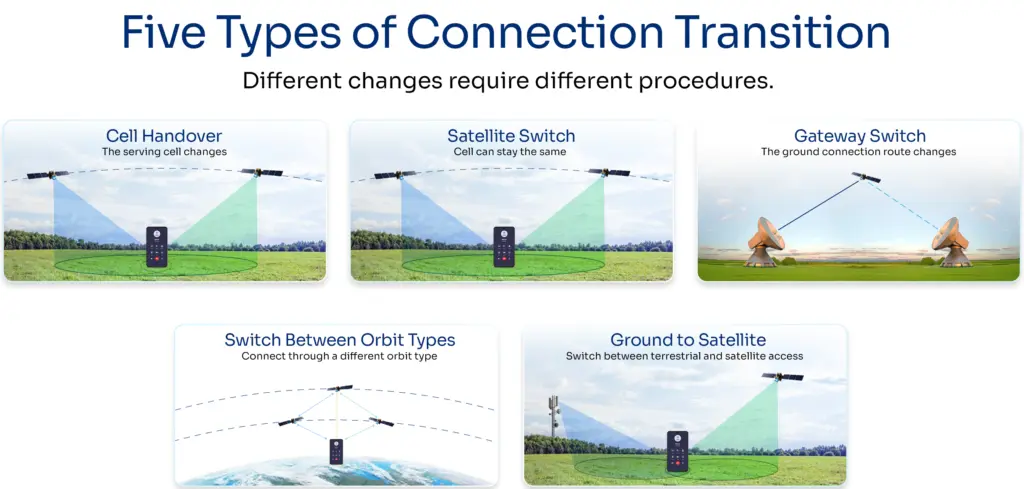
Five Transition Types — A Taxonomy That Matters
Cell / gNB handover. In a conventional cell handover, the UE transitions to a different logical cell and/or serving RAN node, with corresponding RRC and context-transfer procedures. In an NTN system, depending on the deployment architecture, the serving satellite may also change. This is the closest NTN analog to terrestrial handover; however, propagation delay, satellite mobility and associated timing dynamics, and orbital geometry make it structurally different.
Satellite switch with resynchronisation. The physical serving satellite changes but the logical cell and gNB relationship is preserved. The UE adapts its synchronization state, timing advance, and Doppler compensation to the new satellite’s trajectory without requiring a logical cell handover. Treating this as a full cell handover triggers unnecessary signaling and introduces interruption where none is required.
Gateway / feeder-link switchover. The UE-facing radio interface may remain unchanged, but the change in feeder link can affect RAN connectivity, latency, packet ordering and, depending on architecture and implementation, UE connection continuity.
Inter-orbit transition. Mobility between satellites at different altitudes (LEO to MEO, or LEO to GEO) involves qualitatively different delay regimes, Doppler profiles, and timing reference hierarchies. The UE moves between systems with fundamentally different physical characteristics.
TN-to-NTN and NTN-to-TN domain crossing. The UE may need to adapt to substantially different timing, frequency, synchronization and mobility parameters, with corresponding changes in the RAN and potentially the core-network path. Multiple physical-layer assumptions may change simultaneously, making this one of the most complex transitions from a synchronization and mobility-management perspective.
Architecture note: A transparent (bent-pipe) payload and a regenerative payload produce different transition types for the same orbital geometry, and therefore different failure modes when the wrong mobility logic is applied. The taxonomy is determined by architecture choices, not by orbital geometry alone.
Why RF Measurements Alone Cannot Drive NTN Mobility
RF measurements alone provide a weak basis for anticipating serving satellite and beam transitions. A satellite’s field of view is very large compared with the footprint of any single spot beam, so even with a high beam count, only a small fraction of the field of view is illuminated by active beams at any given time. The RF conditions a UE sees therefore depend on which beams are active, how they are configured, and the satellite’s altitude and elevation angle relative to the UE. Each combination of these produces a distinct RF signature. Current and recent measurements are consequently a poor predictor of future radio conditions, and conventional measurement thresholds may be crossed abruptly, or not at all, before a transition is needed. Orbital motion offers a partial counterweight. Satellite position, velocity, and elevation-angle evolution can be predicted in advance from ephemeris, and nominal beam layout can be predicted from network configuration. Geometry alone, however, cannot predict the RF conditions a particular beam configuration will produce at a particular location. The design challenge is to integrate predictable geometric and RF information with measured RF conditions.
Correlated mobility amplifies the problem. In terrestrial networks, mobility events are statistically independent. In NTN, a large population of UEs sharing the same moving beam geometry approaches the handover boundary simultaneously. The RAN can face a highly correlated transition event, with large populations of UEs approaching the same geometric boundary at approximately the same time. That is not a faster version of the terrestrial signaling load; it is a qualitatively different planning problem.
Propagation delay compounds every multi-step procedure. Propagation delay makes every additional signaling round trip more consequential than in terrestrial RANs, particularly for procedures that require sequential exchanges. Preparing transitions in advance and executing them quickly is therefore an important system level design principle, not simply an optimization preference.
From Reactive to Predictive Mobility — What 3GPP Has Introduced
The 3GPP responses to NTN mobility are best understood as responses to specific transition types, not as a general feature inventory.
Conditional Handover (CHO) with NTN-specific triggers
Conditional Handover (CHO) with NTN-specific triggers addresses transition types 1 and 2. 3GPP enhanced by adding time based and location-based execution conditions alongside conventional radio-measurement triggers. Time-based CHO instructs the UE to execute the handover within a predetermined time window based on expected satellite movement and coverage; location-based CHO allows the UE to assess its position relative to configured source and target cell reference locations. Both approaches exploit the predictable nature of orbital motion without discarding RF measurements.
RACH-less handover & satellite switch
RACH-less (Random Access Channel) handover, introduced in Release 18, eliminates the random-access step when timing and mobility context can be pre-provisioned directly reducing service interruption time and the signaling load created by correlated mobility events. Satellite switch with resynchronization is treated by Release 18 as a formally distinct procedure from conventional handover: the UE adapts its synchronization state to the new satellite without a full cell-level transition, avoiding the signaling overhead and interruption that misclassification would introduce.
NTN-to-TN and TN-to-NTN mobility enhancements
NTN-to-TN and TN-to-NTN mobility enhancements in Release 18 extend management to type 5 transitions, where the UE must handle simultaneous resets of timing reference, TA, frequency profile, and synchronization context. Release 19 is consequential for all five types through regenerative payload support: when gNB functionality resides onboard the satellite, mobility between satellites can become an inter-gNB mobility problem, potentially involving context transfer and coordination over standardized inter-gNB interfaces. What Release 19 does not resolve: DAPS (Dual Active protocol Stack) handover remains unsupported in NTN, and cross-operator, multi-constellation service continuity still presents interoperability challenges that exceed any single standardized procedure. Those are the problems Part 2 addresses.
Architecture Determines the Transition
The transition taxonomy only becomes actionable when mapped to the architectural choices that determine which types actually occur. Two decisions are primary:
Earth-fixed vs. Earth-moving cells
Earth-fixed cells generate more frequent logical cell transitions and concentrate signaling at beam-edge geometry. Earth-moving cells reduce logical handover frequency but change the timing of when transitions must be prepared. The choice directly determines which transition types dominate, at what cadence, and what the RAN must handle simultaneously.
Transparent vs. regenerative payload
A transparent payload keeps gNB functions on the ground; transitions are primarily gateway and air-interface events. A regenerative architecture places the gNB, or specified gNB functionality depending on the architecture, onboard the satellite, so transitions may involve onboard processing state, satellite-to-satellite coordination, and ISL-mediated context transfer. The five-type taxonomy maps differently onto each, with different failure modes and different validation scope.
RAN Architects
For RAN architects, this means designing triggering logic and failure recovery for each transition type separately, not simply as variations of one procedure. For MNOs and service providers, it means that SLA design cannot assume mobility timing is driven primarily by user behavior; orbital mechanics, network architecture, and radio conditions can determine when transitions must occur. For D2C chipset teams, it means the device must handle different combinations of timing adaptation, synchronization reset, and mobility execution across these transition types within consumer grade constraints, and that testing only conventional cell handover leaves important behaviors associated with the other transition types unvalidated.
Toward a Transition-Aware Mobility Architecture
Handover in LEO NTN is not solved by faster signaling. It is solved by correctly classifying the transition first. The 3GPP mechanisms across Releases 17, 18, and 19 including CHO with geometry-based triggers, RACH-less execution, satellite switch as a distinct procedure, cross-domain mobility enhancements, regenerative payload support, are largely the right responses. Whether they work in practice depends on whether the system applies the right mechanism to the right transition type, rather than defaulting to a single pattern for all five.
Recognizing the taxonomy is the design prerequisite. Proving that the implementation honors it under real orbital conditions is the validation challenge. That is the question Part 2 of this article will answer: what it takes to reproduce all five transition types in the lab with the physical consistency and timing fidelity that real LEO dynamics demand.
A system that handles transition type 1 correctly and treats the other four as variants of the same event will pass static laboratory benchmarks and still fail at beam-edge geometry, gateway switching boundaries, and cross-domain crossings in the field. The taxonomy is not a classification exercise. It is the architecture.
Five Transition Types at a Glance
Five transition types — what changes, 3GPP mechanism, primary failure mode if misclassified, and relevant specification.
| Transition Class | Relevant 3GPP Mechanisms |
|---|---|
| 1 Cell / gNB handover | Conventional handover (HO), Conditional Handover (CHO), RACH-less handover where supported |
| 2 Satellite switch with re-sync | Satellite switching with UE resynchronization; timing advance and synchronization adjustments without necessarily requiring logical cell handover |
| 3 Feeder-link switchover | Feeder link switching and associated network procedures; NG or Xn signaling where applicable; transport continuity and packet reordering mechanisms |
| 4 Inter-orbit mobility | Conventional HO or CHO where applicable; satellite switching and resynchronization; regenerative payload mobility procedures depending on architecture |
| 5 TN ↔ NTN | Cell reselection, redirection, and connected mode mobility procedures where supported, including inter-RAT mobility enhancements |
FAQ
Why is handover more complex in Low Earth Orbit (LEO) Non-Terrestrial Networks (NTN) than in terrestrial 5G networks?
What are the five main types of transitions in LEO NTN?
- Cell/gNB handover: The UE moves to another logical cell or gNB, requiring radio resource control (RRC) signalling and context transfer.
- Satellite switch with resynchronisation: The serving satellite changes while the logical cell relationship is preserved.
- Gateway/feeder-link switchover: The ground gateway or feeder-link path changes while the serving satellite remains the same.
- Inter-orbit transition: The connection moves between satellites at different orbital altitudes, such as LEO and MEO or GEO.
- TN-to-NTN or NTN-to-TN transition: The UE switches between terrestrial and non-terrestrial network domains. Each transition has different synchronisation, signalling, and service-continuity requirements.
Why are traditional RF measurements alone insufficient for NTN handover decisions?
How do 3GPP enhancements improve handover performance in NTN?
Across Releases 17 and 18, 3GPP introduced NTN mobility enhancements, including time- and location-based Conditional Handover (CHO), RACH-less handover, and satellite switching with resynchronization. Release 19 further extends NTN capabilities, including support for regenerative satellite payload architectures. Together, these enhancements address the unique mobility challenges of NTN, helping reduce service interruptions and improve connection continuity across different satellite and network architectures.